
Have you ever thought about getting your family into bug eating ? It might sound a little strange at first, but billion of people around the world eat insects as insects are actually really tasty, and also good for you. By eating insects, even if just a couple of times a week you will help the planet greatly. Let’s explore why kids like you should give edible insects a try!
The main reason why children will not try insects, is that they are influenced by some adults that treat the idea as gross! in spite of edible insects having been shown by research to be healthy and eco-friendly. We have seen this first hand, for example when running Future Food Lab workshops in schools; the kids would be very curious about trying, but the same cannot be said about the teachers ! Similarly when running events like Scouts conventions and similar large gathering, we’ve seen how children of all ages are curious about trying eating insects but not the accompanying adults !
The Nutritional and Environmental Case for Entomophagy For families
Superior Health Benefits
Insects are a nutritional powerhouse. They are packed with high-quality protein essential for muscle growth and repair. Beyond protein, they are rich in vital micronutrients that children often lack, including:
- Iron & Calcium: For strong blood and bone development.
- Omega-3 Fatty Acids: Critical for brain health.
- Vitamin B12: Which boosts energy levels and supports the nervous system.
2. A Win for the Planet
Raising insects is incredibly sustainable. Compared to traditional livestock like cows or chickens, insects require significantly less land and water. They are champions of the “circular economy” because they can thrive on vegetable surplus, creating a low-waste food system with a fraction of the greenhouse gas emissions.
3. Surprising Flavors
What do they taste like? Most people describe crickets and mealworms as having a mild, nutty, or umami flavor.
- Crickets are often compared to roasted sunflower seeds or popcorn.
- Mealworms can taste like toasted nuts or even crispy pork scratchings when fried. Because their flavor is subtle, they are “flavor sponges” that soak up whatever spices or seasonings you enjoy!
4. A Global Delicacy
While new to some Western diets, insects are a staple for over 2 billion people worldwide. From crispy chapulines (grasshoppers) in Mexico to savory bamboo worms in Thailand, bugs aren’t just “survival food”—they are celebrated delicacies sold in vibrant street markets and high-end restaurants alike.
Edible insects are crunchy, tasty, and great for you and the planet. Go ahead, take a bite, and be part of the bug-eating adventure!
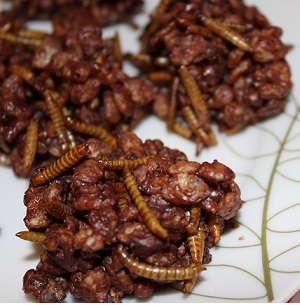
- Try them covered in chocolate with some Choco-pops.
- Ask your parents to help you cook a bug recipe, like cricket tacos or cricket guacamole.
- Share what you learn with your friends—it’s fun to eat bugs together!
How to try edible insects – Practical “First Try” Ideas
- The “Gateway” Snack: Snack on roasted mealworms—they have a nutty, popcorn-like flavor that is less intimidating than crickets.
- Smoothie Booster: Add a tablespoon of insect protein to a fruit smoothie; it provides a creamy texture without altering the flavor.
- The “Dino-Food” Angle: Use storytelling. Framing insects as “jungle explorer food” or “superhero snacks” helps bypass the “ick” factor often learned from adults.
Are edible insects suitable for children ?

Edible bugs for kids are safe and healthy to eat, provided they are food-grade insects, not “wild-caught” garden bugs, which may contain pesticides, parasites or harmful bacteria. In the UK only certain species can be sold for human consumption like for example crickets, locusts and mealworms. In other countries a lot more species are available, and they are even consumed as a delicacy school lunches ! from ants to beetles and even scorpions, . If you find the sight of insects in your food puts you off, remember that you have the option to turn them into snacks by grinding them first and mixing them in with other ingredients.
Why children should try eating insects?
Because insects protein for children are a pediatric powerhouse as they provide a rare combination of highly bioavailable iron (critical for cognitive development), prebiotic fiber (for gut health), and Vitamin B12, often in concentrations exceeding traditional livestock. For children with small appetites, insects provide a more “nutrient-dense” bite, delivering essential growth minerals like Zinc and Calcium without the high saturated fats found in red meat.
How can edible insects help with fussy or “picky” eaters?

Edible insects are surprisingly effective for fussy eaters because they can be seamlessly integrated into familiar foods without the “challenging” textures (like gristle or fat) found in traditional meat. Because many insects have a neutral, nutty flavor profile, they act as a “stealth health” ingredient that boosts nutrition without triggering sensory aversions.
Why insects work for picky palates:
Consistency is Key: Fussy eaters often reject meat due to inconsistent textures. Cricket powder offers a perfectly uniform texture that can be baked into muffins, pancakes, or pasta dough, providing high-quality protein without the “chewy” hurdles.
The “Flavor Chameleon”: Roasted insects, particularly mealworms, have a mild, savory flavor similar to toasted nuts or popcorn. This makes them much easier to introduce than the strong, iron-heavy taste of liver or red meat.
Gamification of Food: For many children, the “ick” factor is actually an “excitement” factor. Rebranding insects as “adventure food” or “superhero fuel” can break the power struggle at the dinner table by turning mealtime into an interactive experience.
Small Volume, High Impact: Picky eaters often eat small portions. Because insects are so nutrient-dense, a child can get their daily requirement of Vitamin B12 and Iron in just a few bites, reducing parental stress over “half-finished” plates.
Expert Tip for Parents: Start with “Invisible Insects.” Use a 10-15% substitution of cricket flour in your standard baking recipes. The color may darken slightly (similar to whole wheat), but the taste and texture remain virtually unchanged, allowing your child to acclimate to the nutrition before they ever see a “bug.”